The Eating Iceberg Explained
"What to Eat" doesn't even begin to address what ails you.

<div id="buzzsprout-player-14477738"></div><script src="https://www.buzzsprout.com/2297813/14477738-the-eating-iceberg-explained-what-to-eat-doesn-t-even-begin-to-address-what-ails-you.js?container_id=buzzsprout-player-14477738&player=small" type="text/javascript" charset="utf-8"></script>A couple conversations about how our environment impacts food choices were top conversations with clients this week, and so this post is dedicated to them and I’m honored to be able to share some of their insights with you today.
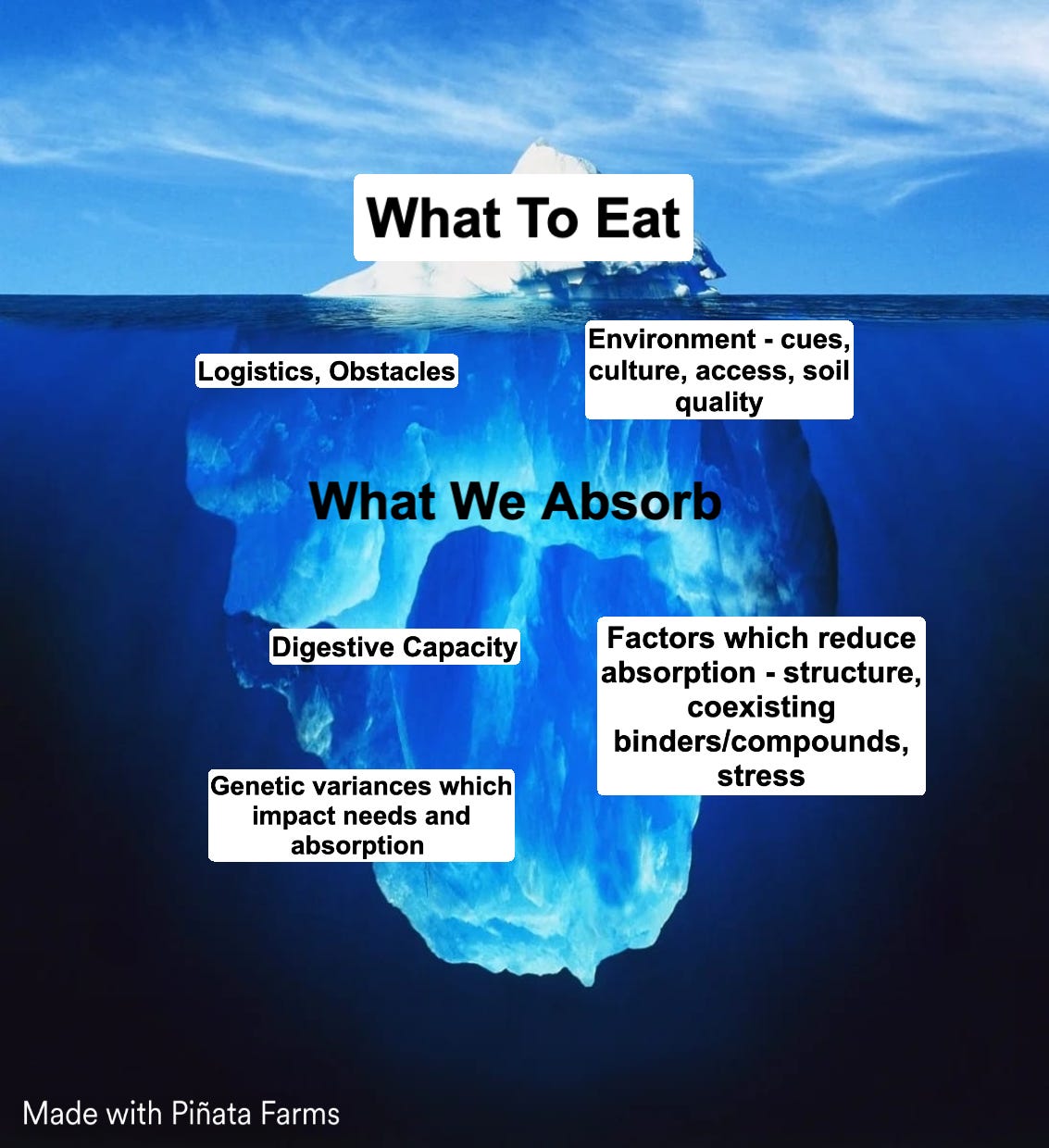
Sometimes a prospective client will come in and candidly inform me that they just need to know what to eat, because what they have been trying isn’t working. Most nutrition advice insists upon staying at this tip of the iceberg and really neglects a whole lot of shit that sits below the surface of that question. In today’s episode, I’m going to dive into the icy waters and report to you on several of the things that we often do not even get a chance to address when we stay focused on ‘what to eat’ and how much that impacts whether or not you actually are able to implement and benefit from the correct answer to that question.
Now most people struggle to implement diet, exercise and lifestyle advice for a whole host of reasons. While some people feel willpower is their biggest challenge, (see episode 3, Beyond Smart Goals Part 2 to address this) the majority of seasoned health enthusiasts realize that implementation is where things fall flat.
Perhaps it is that they are only able to implement their healthy diet for a period of time, and then life gets in the way, or perhaps they find the requirements to stay on one plan or another were too strict or too disruptive. That said, what I commonly hear from people is again a level of self-blame, “if i could just get my shiz together, if i could just meal plan like i know i need to, if I could just DO the program then i wouldn’t have a problem.”
This neglects to acknowledge the fact that change is a challenge and, if you are like most of us, you have a lot going on that competes for your attention. A major dietary change requires a significant amount of investment in time, forethought, planning and sometimes money to execute properly. If we go all in all at once, ( like many of you perfectionists out there love to do) it exceeds most people’s capacity to sustain that degree of change. Inevitably they miss a week of meal planning, the kids gets sick and they can’t get to the gym that week, and then things begin to unravel from there.
This is why I insist with nearly all my clients that we begin with incremental changes that can bring immediate impact and immediate successes. Mastery of anything new is a process that takes time, and starting with some of the easiest wins, recommitting to 1-2 things that you know work well for you, allow you to course correct and shift your health in the right direction without upending your family life or threatening your job. In time we are able to delve deeper into the obstacles that persist in derailing your efforts, and in doing this my clients often discover that even though they had originally come to me to figure out ‘what to eat’ the process of answering this has allowed them to explore a multitude of areas that have been eroding their health and wellness for decades.
A common place is this initial layer beneath the surface of one’s environment. In the Western industrialized world, our very environment competes against our health and longevity. We are incessantly interrupted and distracted by our phones in addition to family and our work demands, and these competing demands take up real estate in our brain and time to devote to planning, prepping, and changing. I’m not suggesting you send pooch to the pound or quit your job, but to pretend that your weekly happy hour with coworkers or your daughter’s food sensory issues are not a significant obstacle that is to be ignored is a recipe for failure, hands down. Most people aren’t willing or able at the onset to tell their boss they will no longer be responding to work notifications after 5pm because they want their freaking life back. In the US, anyway, that privilege has been eroded away the last 5 years and has to be reclaimed, one person at a time, if we are going to have any kind of hope for a healthier work environment.
More on that in a moment.
So - at the tip of the ice berg is what to eat. Below that we have our personal life and how life demands consume enough of our attention that resources to make big sweeping changes even less reasonable now. Unless you are on some new drive-thru diet (and maybe I need to sell a book touting this as the answer to our problems) you are going to have to take some time to learn new habits, new recipes, new foods and this takes time away from other, longer established demands upon you, right.
Then we dive deeper still, and let’s just look at our entire cultural environment and how it impacts “what to eat”…
I was having a conversation with a friend and former client about how the food culture in much of Europe is very different than what we are accustomed to in North America and the UK. America, always intent on outdoing her neighbors, still leads the way in terms of the pervasiveness of marketing and ubiquitous cues in our environment to always be snacking. I mean, why the hell do we need to peruse through a whole aisle of junk food on our way to the cashier when at an office supply store? We have so many overt cues pushing food - but NOT vegetables - on billboards, commercials, clothing, cashiers, and vending machines EVERYWHERE that many of us simply do not really have regular experiences of hunger. We have so many external cues to eat, from what time we are allowed to have lunch to how many advertisements we drive by, walk by, scroll by, and watch in a day prompting us repeatedly to eat unhealthy foods for reasons that have nothing to do with hunger or nutritional need. By time we exit high school many of us are out of touch with our innate hunger and satiety cues and, if we stay focused on everything but our health, we won’t hold onto it for much longer than our tenth high school reunion.
The economics of what to eat is also a hot topic, especially as food prices all over the world continue to be driven up by the instability of our times. In the United States, the healthiest foods are the most expensive, and the hyperpalatable foods heavily featured in advertising contain ultra-processed forms of corn, wheat and soy that is heavily subsidized by the government, making them cheaper than the foods our body actually needs to thrive. To add insult to injury, the governing body responsible for dispensing health and nutrition information is also responsible for maintaining a viable, profitable food industry and sometimes these are conflicting agendas, you know? So we have a subsidized nutrition program that permits soda to be purchased with food stamps and this results in Coca Cola receiving significant profits from government subsidized food stamp programs. That’s your tax dollars at work, folks!
But when milk is far more expensive than soda, and a family size bag of potato chips is cheaper than unprocessed vegetables, it’s easy to see how those living near or below the poverty line struggle even earlier and more severely with obesity, diabetes, and heart disease. This situation is of course more complex than the current foods they can afford, but again the point here is that the desire to eat healthfully requires a great deal of persistent pushback against the pervasive environment.
In much of the industrialized world, we have this encroachment of marketing and advertising, coupled with increasing work loads, commutes, and stress, which push against our ability to eat a healthy diet. If you are just going about your business and living your life, you are unknowngly skipping down the yellow brick road to multi-organ chronic disease. That’s just the inevitable outcome of not paying attention to your health before you need to. We no longer have the luxury of ignoring it, because it is becoming a big-ass issue earlier and earlier in our lifespans and the nature of our environment prevents us from keeping our health into our elder years.
The ice berg goes DEEP, my friends.
Tangentially to this, I was speaking to a client this week about work life balance and how the demands from work were so chronic and pervasive that this person did not fully realize the degree tow hich stress was impacting the quantity and quality of his food choices until he began setting boundaries at work to reduce his stress load. This is something I am seeing ALL THE TIME now, and it really took off during the pandemic when everything was uncertain and it was all hands on deck across many sectors. Many of the last guardrails that divided work life from home life were removed and I would talk to people who’s bosses started scheduling meetings at 7am because no one was commuting any longer. Meetings would continue until past 6pm for the same reason. People reported to me they were usually skipping lunch because they did not feel they could leave their desk, they worked too late to properly prepare a quality dinner, and so increasing reliance upon our improved and efficient food delivery driver service made it that much easier to work through lunch, eat dinner at your desk, clock off and pass out, then wake up early the following day to repeat that process. Many of the clients I have spoken to since the pandemic ended report these invasive expectations have remained - never explicitly demanded, but the CULTURE of their work environment has kept it entrenched as the unwritten law of the land. Those who take time to go dine with family or go to the gym do not do as well at performance reviews, receive social pressure from coworkers to stay alongside them, or are met with such a backlog of emails and slack notifications when they get back to the desk that they feel it is less painful to just stay put and work through meals. But this cycle will not end unless we decide for ourselves to end it. This past year - 2023 - I began seeing more and more of my clients push back against this as they are burned out, exhausted, and very literally sick from it. This kind of experience crosses a multitude of job sectors and is really the ‘new norm’ for most of the people i work with. It is just not right.
So when you come to me and you say, ‘I just need to figure out what to eat’, I’m not immediately thinking about your vegetable intake; I’m wondering how much of this is true for you, and how we are going to navigate this in a way that works for you. What to eat is more often the easy part.
To go even deeper, lets’ say you’ve got the logistics in place, can make the (and i am air quoting here) right food to eat.
Our nutrition status is not about what we eat, so much as what we absorb.
Our body needs energy and vitamns and minerals. We know this. I am going to go out on a limb and say we also need antioxidants and phytonutrients to maintain health but these are not yet recognized as essential by the governing bodies of my profession. We can get these things from foods, BUT - and here’s the clincher - we might not be absorbing them. This could be due to:
Digestive issues, starting from the quality of our teeth to the acidity of our stimach to the composition of our gut microbiome
Compounds in foods which bind to nutrients and inhibit absorption (phytates)
The exact nature of the nutrient we are ingesting - omega 3 from fish vs flax, heme vs non heme iron
Genetic SNPS (such as MTHFR) which impact absorbability of nutrients or increase demand of a nutrient.
Additionally, genetic SNPs are influenced by the environment, so simply having a gene doesn’t dictate dietary needs; whether or not that gene is being expressed affects the impact on the body system. This is pertaining to a field called epigenetics, which is deeply fascinating in and of itself.
The overall quality of one’s life, such as a high stress lifestyle inhibits the body’s ability to properly digest and assimilate food
This is why someone can be eating a very healthy diet and still not be seeing the results they expect. Or, in the case of digestive-rooted issues, why someone finds it impossible to eat what they feel should be healthy for them because it makes them feel sick. Then some wacky doctor comes out with some crackpot theory that plants are trying to murder you and no one else has an answer for why salads make you double over in pain so you think, you know, maybe he is on to something?
I assure you, he is taking a sand-sized grain of truth and turning it into Mount Vesuvius. It’s actually more complex than that.
When it comes to even our healthy foods, the vitamins, minerals, and antioxidants that were present in these foods are less now than 2 generations ago. So the healthy foods that we eat are less nutrient dense and we probably need to eat even more of them to get the same benefit our forefathers did.
This is largely due to mono-cropping, lack of healthy soil, topsoil erosion, and the increase of CO2 in the environment which, surprisingly, actually impacts the minerals in our foods, iron zinc and magnesium particularly. So you can be eating a whole foods diet, but still fall short.
Addressing this requires knowing things we do not know, and going full on old school organic for 100% of the diet is not sustainable for most. Irrespective of how the environment has changed nutrient density or how digestive function, genetics and stress impairs absorption and nutrient needs, 98% of us are still not consistently meeting the current recommended dietary intakes, which are really just a staring point for optimal health. So first thing is first - get that part taken care of, ideally from food as much as possible, and then if there are still problems those are the places to look.
That said, my confidence that our current knowledge base on what optimal nutrient needs are, and how well any kind of existing genetic test can determine what you need and how much of it is not very high.
Guys - I’m running out of oxygen here so Im going to have to come up for air, get back on my boat, and speed away from this iceberg. Its all i can handle today. An extra shout out and thank you to the client who gave me the idea to turn our conversation into an iceberg episode! You know who you are!
I have a great surprise for you though! Next week I’m going to be interviewing one of my most influential peers in the nutrition space. This man is among the top 3 people that changed how i practice nutrition and transformed how I go about meeting my clients needs. I can’t wait for that show to drop, and I hope you’ll tune in when it launches next week.
As always, if you feel this might be helpful to others, please share, telling your peeps what part of the iceberg gave you the most food for thought!
Until next time!
Resources:
Stover PJ, Caudill MA. Genetic and epigenetic contributions to human nutrition and health: managing genome-diet interactions. J Am Diet Assoc. 2008 Sep;108(9):1480-7. doi: 10.1016/j.jada.2008.06.430. PMID: 18755320; PMCID: PMC5421377.
Mullins VA, Bresette W, Johnstone L, Hallmark B, Chilton FH. Genomics in Personalized Nutrition: Can You "Eat for Your Genes"? Nutrients. 2020 Oct 13;12(10):3118. doi: 10.3390/nu12103118. PMID: 33065985; PMCID: PMC7599709.
Mother Earth Living; Hot and Hungry: How Climate Change Affects the Nutrient Content of Our Food